
1. What is PoE – Power Over Ethernet?
Power over Ethernet (PoE) does exactly what it says — it carries power over ethernet cables. So, an ethernet cables caries both data and current together to operate devices like wi-fi access points. This is very helpful to install wi-fi access points in ceilings, where it is hard to find power outlets. Only smaller devices can be powered using the PoE, as it carries limited power over the ethernet.
![[PoE Setup]](https://static.thegeekstuff.com/wp-content/uploads/2008/12/poe.jpg "[PoE Setup]")
Fig 1: A Typical PoE Setup (Image From: PowerOverEthernet.com)
2. How does PoE works?
Following are the terminologies used in the PoE network:
- PD – Powered Devices: PDs are end devices that can accept the power transmitted over Ethernet Cat-5 cable.
- PSE – Power Source Equipment: PSEs add power to the ethernet cable.
- Midspan device: These are power injectors that stands between the standard ethernet switch and the end device.
- Endspan devices (PoE Switches): These are Ethernet Switches that includes the circuit to inject power to the ethernet cable.
Cat5 ethernet cable has 4 twisted pairs. Out of 4 pairs:
- 2 pairs are used for data transfer,
- 2 pairs are spare and not used.
There are two approaches to transfer power over ethernet.
Approach 1 uses data pairs:
The same 2 pairs used for data transfer, is used to carry power. The PSE injects power to the 2 data pairs (pin 1,2 and pin 3,6) via the center tap of the transformers without affecting the data transfer.
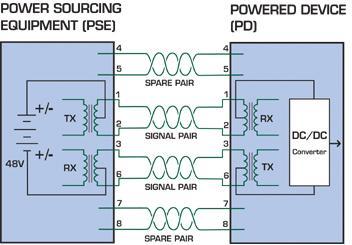
Fig 2: PoE Approach 1 uses data pairs to send power (Image From: PowerOverEthernet.com)
Approach 2 uses the spare pairs:
The 2 spare pairs that are not used, is used to carry power. It applies +ve voltage to pins 4 and 5 of ethernet cable. It applies -ve voltage to pins 7 and 8.

Fig 3: PoE Approach 2 uses spare pairs to send power (Image From: PowerOverEthernet.com)
3. What are the Benefits of PoE?
- Portability: Install end-devices where it is hard to get power. For example, you can install a wireless access point in the ceiling, where you cannot find power outlet.
- Cost Savings: For a large scale deployment of wireless access point, you don’t need to install power outlet for the access points, which can be a huge cost saving.
- Simplicity: You need to run only ethernet cable to the end devices, which eliminates the cable clutter.
- Safer: No AC power is involved, as you don’t need to install A/C power outlet for the end-devices.
- Easy Maintenance: You can restart the end-device remotely. No need to press the power button to reset the equipment. You can easily move the end-devices wherever you can lay a LAN cable.
4. Sample List of Equipments that uses PoE.
PoE Adapters:
 D-Link Power over Ethernet (PoE) Adapter – DWL-P50
- D-Link Power Over Ethernet Adapter – DWL-P200
- Linksys Power Over Ethernet Adapter Kit


PoE Wireless Access Point:

PoE Switch:
PoE Network Surveillance Camera:
- Airlink Power over Ethernet Network Camera – SkyIPCam310
- Panasonic 21x Optical Zoom Pan/Tilt Network Camera – BB-HCM580A
- Mobotix Outdoor, Wide Angle Lens, Motion Detection Camera D22M-IT


PoE VoIP Phone:

PowerOverEthernet.com site maintains a Huge List of all PoE products, including a PoE Analog Clocks and PoE Gas Detector.





Comments on this entry are closed.
i have a nortel POE switch in one building and a smaller network in another building i have a fiber linking the tw obut have a normal media converter to change the media at both ends. my question is will the power from the POE switch affect the media converter since it is plugged directly into one of those ports .
Hi William, the answer is No.
Part of the specification of POE 802.3af and POE+ 802.3at as not to cause damage to equipment, requires a negotiation to take place between both devices before applying the PoE power of which there are three phases called detection, classification and operation.
Hope this helps
I have a 550MHZ CAT6 BLUE PLENUM CABLE 1000 Feet, I want to know that is this cable is compatible with POE devices? I have to install this cable with my POE device.
Please answer early as possible.
Thanks.
Joe,
That cable should work. CAT 6 has 4 twisted pairs, two of which are used for data and another 2 that are used for power.
Hi,
Is there a way out in Linux to do the PoE task instead of having it in the hardware. Let me know if anything can help to achieve this.
Hi Mark,
Is there any way out to simulte PoE in linux. Please let me know.
Regards,
Yashpal
Hi,
We are using POE switch for CCTV camera. But in one of our site some where Cat6 6 cable damaged and checked the continuity found only 2 pairs continuity are live another 2 pairs are damaged.
Is it possible to use the same cable using only 2 pairs because its very difficult to change the cable.
Kindly suggest.
sir ,,,,tell me the names in which we use power over ethernet