
As part of the contest that was conducted a while back, I got around 200 responses from the geeky readers who choose their favorite Linux distributions.
Based on this data, the top spot in the best Linux distribution list goes to…
Ubuntu
My personal favorite was Ubuntu for desktop (#1 in this list) and Red Hat for servers (#5 in this list).
If you are new to any of the distros listed in the top 5, read the rest of the article to understand little bit more about those distros and find out whether your favorite Linux distribution made it in the top 5.
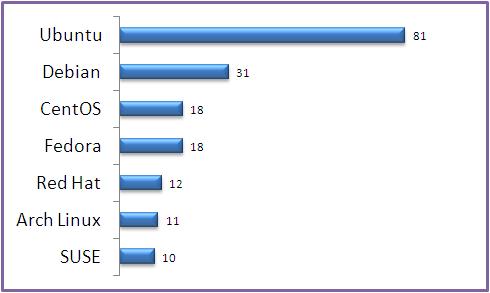
Fig: Favorite Linux Distribution Voting Results
1. Ubuntu

Like most of you, Ubuntu is my #1 choice for desktop Linux. I use it both at home and work. Ubuntu is the #1 in the Linux desktop market and some use Ubuntu for the servers also. Ubuntu offers the following three editions.
- Ubuntu Desktop Edition
- Ubuntu Server Edition
- Ubuntu Notebook Remix
Additional Details:
- Home Page: http://www.ubuntu.com
- Ubuntu Download Page
- Created by: Canonical Ltd., (who also provides commercial support, if you need it)
- Used As: Desktop and Server
- Latest Version: Ubuntu 9.04
- Read more about Ubuntu Distribution at wikipedia.
Refer to our Ubuntu Tips and Tricks article series.
2. Debian

Debian is also called as Debian GNU/Linux, as most of the basic OS tools comes from the GNU Project. Lot of other famous distributions are based on Debian, which includes our #1 distro Ubuntu and many others — such as Knoppix, Linspire, Damn Small Linux etc.,
Additional Details:
- Home Page: http://www.debian.org/
- Debian Download Page
- Created By: Ian Murdock
- Latest Version: Debian 5.0.1
Read more about Debian Distribution at wikipedia.
3. Fedora

Fedora is sponsored by Red Hat. If you are interested in experimenting with the the leading technologies, you should use fedora, as the release cycle is very short and fedora tends to include the latest technology software/packages in it’s distribution.
Additional Details:
- Home Page: http://www.fedoraproject.org/
- Fedora Download Page
- Created by: Fedora Project (sponsored by Red Hat)
- Latest Version: Fedora 11
- Based On: Red Hat Linux
Read more about Fedora Distribution at wikipedia.
4. CentOS

If your organization does not want to spend money on purchasing Red Hat support, but still want all the benefits of the red-hat distribution, this is obviously the best choice, as this is totally based on the red-hat enterprise Linux.
As you can imagine the Nort American Enterprise Linux vendor mentioned in the quote below is Red Hat.
From the CentOS website: CentOS 2, 3, and 4 are built from publically available open source SRPMS provided by a prominent North American Enterprise Linux vendor. CentOS is designed for people who need an enterprise class OS without the cost or support of the prominent North American Enterprise Linux vendor.
Additional Details:
- Home Page: http://www.centos.org/
- CentOS Download Page
- Created by: CentOS Project
- Latest Version: CentOS 5
- Based on: Red Hat Linux
Read more about CentOS Distribution at wikipedia
5. Red Hat

This is my favorite server distribution. If an organization doesn’t mind spending dollars on purchasing the red-hat support, this is always my #1 recommendation to any organization who runs mission critical applications.
On a side note, one of the reason I like Red Hat Linux for mission critical production application is that Red Hat tends to take some of the new features from Fedora, which is well tested by the community.
Additional Details:
- Home Page: http://www.redhat.com/
- Red Hat Download Page
- Created by: Red Hat
- Latest Version: Red Hat Enterprise Linux 5
Read more about Red Hat Distribution at wikipedia.
Awesome Linux Articles
Following are few awesome 15 examples articles that you might find helpful.
- Get a Grip on the Grep! – 15 Practical Grep Command Examples
- Linux Crontab: 15 Awesome Cron Job Examples
- Mommy, I found it! — 15 Practical Linux Find Command Examples
- 15 Examples To Master Linux Command Line History
- Unix LS Command: 15 Practical Examples
Note: To get high quality free Linux articles, subscribe to the geek stuff.





 My name is Ramesh Natarajan. I will be posting instruction guides, how-to, troubleshooting tips and tricks on Linux, database, hardware, security and web. My focus is to write articles that will either teach you or help you resolve a problem. Read more about
Comments on this entry are closed.
RE: Top 5 Best Linux OS Distributions
Linux Mint, a distribution based on Ubuntu didn’t make the top five. Where did it place in your survey?
Regards,
Ken
Gentoo is best for me.
I also think Linux Mint should be between the top five.
i think that we should do the survey separately
for servers and desktops..
i do hands on 2nd,3rd,5th as per ranking as i spend mostly on servers
never tried other ditros
on server front which is best i wanted to know..
Actually I’m somewhat surprised that Ubuntu would be considered the “top” among the geeky readers. Most of the comp sci “geeks” I knew before liked their flavor of Linux for the geek-niche factor and their ability to esoterically modify everything about it. So, I would hear about gentoo or RedHat or some other type of Linux a lot but not Ubuntu because it seemed too easy, too watered-down and too popular.
@Joshua, Maybe it’s because we are getting older (my first true Linux install was Debian 1.3 back in the mid 90s) I used to enjoy spending days working on a new install to get things to work right, install all the apps I needed and tweak things to my taste. But now I need my computer to do work and can’t have it down for days while I get it working properly. Ubuntu installs easily, has large repositories and I haven’t had to struggle with any hardware issues for quite some time. Plus if I recommend this distro to a friend to try, I can easily help out if they have a question since I use it on a daily basis.
…from http://www.userfriendly.org
Pitr [thinking]: What?! The Chief is havink Debian runnink on his machine?! outrageous! Nothink a disk wipe and a Suse install will not be fixink.
Chief: Pitr, What are you doing?
Pitr: Installink Suse on your machine, boss man.
Chief: But why? What difference does it make what flavour is on my machine? The shareholders don’t care, my machine doesn’t care, and I certainly don’t care!
Pitr: You see, boss… every time you are clickink mouse in Suse, you feed small hungry child. Every time you clickink mouse in Debian, God, he is killink a kitten.
Chief: Oh my Lord. I had no idea!
Pitr: Just thank gods that you did not use Red Hat! Clickink mouse each time creates new Linux distro!
…as for myself;
I would have picked ubuntu 8.1 but I up/down graded to 9.04 and I have spent as much effort testing/degugging the O/S as I have spent actually doing my own work. I don’t even have any blacklisted hardware in my machine. But Intrepid Ibex was difficult to find fault with.
Anyway, by definition, this is a poll which indicates what our favorite distro is, as opposed to which distro is actually better. That would require a lesson in software metrics from the ACM. : )
…but it could be done.
After all, we’ve always been able to objectively compare apples to oranges when it comes to windows and linux, right? ; )
So why not bust out the hard/soft/derivitive metrics for a distro comparo? There would be no voting involved, sad to say, cause I do love a good online poll, but it would be an incredibly geeky thing to do.
What I can state, based solely on personal experience, is that Knoppix has never (ever) let me down. Using Knoppix for recovery purposes has saved my data everytime.
Knoppix +1 YAy
@All,
Here is the full listing of all the distros that were mentioned as favorite by the users in the contenst.
1. Ubuntu 81
2. Debian 31
3. CentOS 18
4. Fedora 18
5. Red Hat 12
6. Arch Linux 11
7. SUSE 10
8. Slackware 8
9. Gentoo 6
10. Mandriva 4
11. Mepis 3
12. Sabayon 2
13. PCLinux 2
14. Backtrack 2
15. Damn Small Linux 2
16. Mint 1
17. Knoppix 1
18. PrestoMyPC 1
@KenW, Rafael,
As you see in the above ranking, Linux Mint came almost at the bottom. Just both of your votes would’ve pushed it up in the ranking. 🙂
@Srinivas,
I agree. I’m pretty sure that most folks who voted for Ubuntu are using it as desktop. Probably a separate server for desktop and servers may show a different results. We’ll conduct such survey in the blog very soon. Thanks.
@Joshua,
Like Scott has mentioned, it is just too easy to set it up and running. Moreover, Ubuntu is the famous distro among the newbies. Since I didn’t separate desktop vs server distro in the contest, it is no surprise Ubuntu came on the top.
@Scott,
You installed Debian in mid 90’s? mm.. You are definitely as wise as Master Yoda. In mid 90’s I was playing around with Solaris. You are absolutely right about Ubuntu, for some of my non-geeky (read it as — Microsoft, self proclaimed geeks) friends, who wants to know what is all the hype about Linux, I recommend Ubuntu to them.
@cronjob,
Very hillarious discussion between Chief and Pitr. 🙂
You are absolutely right. This list shows only the favorite disto. But technically may not be the best.
It would be interesting to create a poll where every disto can be rated based on features, technical-aspects, functionalities. What are the different technical-aspects you would consider for every distro to be rated, if we have to create such poll?
Hello Ramesh:
Thanks for putting the onus on the customer. : )
Have you ever worked for IBM? ; )
That’s a nice push back though Ramesh. I ask for metrics, and you ask me to get some. lol
(In all actuality, I like the fact that you respond to the geeks that frequent this board. Many such boards put out the info but, give no clue as to whether or not there is anybody who cares on the other side of the web site.)
Anyway, I will start digging.
tayl
Hi
what you told is right. But what happened to linuxmint.
Ubuntu really tops in desktop edition and it is really easy to use than other linux edition
@cronjob,
I never worked for IBM. But, I’ve worked closely with IBM/KPMG/E&Y consultants on different projects. Sometimes putting onus on the customer may be a good thing, which gives the opportunity for the customer to think about their business. 🙂
Anyway, I didn’t mean to push that back onto you. I’m really interested in finding out what kind of metrics you would be interested in seeing. Thanks for start digging on it. Let me know what you find out.
@Vivek,
Thanks for the comment. Like I’ve mentioned to “KenW and Rafael”, Mint got only one vote and just three of your additional votes would’ve pushed Mint from the bottom to a reasonable level. 🙂
Please tell me what is different between each of distributions?
Fedora is my personal favorite, then Arch, then Backtrack.
GENTOO IS BEST
Ubuntu was with i started off with like 3 years back… like one fine day, i had my Windows machine go kaput on me and i was actly tired of the constant reinstallations… so those three days in which i didnt bother to touch my computer, i introduced myself to Ubuntu.. and my word, was i hooked..
i had used Red Hat and Fedora in college. But i didnt know their capabilities.. still dont..
Now around a month back, i have started off exploring Sabayon 4.2 . it looks great, plays great, media and devices work outta the box.. but a lot of the deal is like totally messed up, you can get to points where you end up in dead ends. i want to try something else now… tired of what sabayon is offering.. is it back to ubuntu for me or can you guys suggest me onto something?
For a light-weight distro that runs fast and does most anything people do on a laptop I would say GOS. It’s Ubuntu based but the performance is much faster.
For a full brown distro Ubuntu is nice because it has so many users, great forums, very stable. This is an opensource distro however and you need to add proprietary software to get some common desktop/application features working. Mepis is a really nice distro out of the box that performs most of what you would do on a computer without modification. Suse is stable and easy to work with. Its a bit bulky however and has performance issues on older machines. Fedora is nice but not the most user friendly distro. Mandriva is comparable to Fedora in terms of user experience in my mind. Sabyon is interesting, very cutting edge but a bit unstable and has more hardware compatibility issues than other distros.
Whatever distro you choose perform a search for “distro name perfect desktop” and you’ll find guides to customize the distro (for major distros). http://www.howtoforge.com/the-perfect-desktop-gos-3.0-gadgets for example.
http://distrowatch.com/ is a good source of information on Linux distros.
Good luck and thanks to the many developers, hacks and geeks that provide us so many great choices.
I’m a lifelong Windows user that was just recently introduced to the world of Linux. I’m glad there is a FREE alternative the the $400 for upgrades Microsoft is demanding for a product key for Windows 7…
Anyway, I’m currently using Xubuntu, which is a spinoff of Ubuntu with the Xfce desktop environment. I like it a lot. I tried Mint, Fodera, Ubuntu, Kubuntu, SUSE, and a couple of others. For me, Xubuntu was the easiest, most flexible, and most customizable. Or, I finally got the hang of Gnome by the time I got to Xubuntu… 😉
I’m a newbie on linux. Any advice on what distro should I use on laptop?..
My vote for Ubuntu.
At Ijes16: I would DEFINITELY recommend EITHER Ubuntu or Mint. Both are extremely easy to install as a dual boot (if you choose to keep Windows or OS X on your computer), both are plug-n-play (hardware drivers are automatically detected and loaded, so your stuff just… works), and both are beautiful OS’s with highly customisable GUI’s. Have fun and let us know what you decide and how its working out for you.
I’ve gone thru a vigorous search for the best linux distros 2010 regarding ease of use and functionality as well as its looks. for any windows users especially, who wana try out wat linux is, i recommend the following:
1. JoliCloud ( I loved its concept, its like using iPhone with big tabs and icons.)
2. Linux Mint 8 ( easy to use and pretty)
3. Pardus 2009.1 (best KDE desktop so far and stable with nice collection of software)
Well, I always liked Red Hat, then they started the free desktop version to test the RedHat core called Fedora, but Fedora doesn’t includes some open source free libraries (for GPL sake) so I moved to Debian! Since Ubunto is a Debian branch I stick to Debian just for love. But personally I found Ubunto the most simple to use, simple enough for non IT folks.
Can Somebody tell me which Linux version is the best one to get used to command line in linux. I want to boot in Commandline. I don’t want GUI at all. Which one is the best. If it can be done on Fedora too. Please letme know how to do
Farooq, I’m guessing that what you need is to load the kernel, its modules and little more. Skip loading X and the desktop environment and you’re done! This you can do with just any Linux Distribution!
Remember that Linux is the mostly the Kernel and not the whole set, that’s called a Linux Distribution. The Kernel just by itself would not work by itself, it needs to be loaded, for that you need a Linux Loader (LILO or Grub) (which is basically a boot program that loads the Kernel to the memory and points to the Kernel entry point). The last thing you need it the command line working, to receive and process input from the keyboard and display it on the screen, the common program to do this is Bash. Just having this you can run any simple (independent) binaries, but you will probably end up needing some libraries and some other support apps.
Advice: Try installing a SlackWare distribution from scratch and stop when you have the minimum system running which consists on just the LILO and the Kernel (and the modules, if any). But the easy and fast way is to get one of those incredible small PEN drive distributions because they probably are just what you need.
If you’re on the clock check DSL (Damn Small Linux) it’s a very popular small Linux Distribution.
Have fun!
Ubuntu is simply the best.. I have been using it from its version 7.10…
Only one time I have migrated to Suse, but was not impressed. So I switched back to Ubuntu again, now using the version Jaunty Jackalope…
Ubuntu Rocks…
HI. I have been using some of the distro and Ithink they are pretty good. ilike Fedora,Ubuntu ,Mint and Suse. Which one is better ? All of them really.
you could do a lot wth them. They are improving everytime so i would recommend them to anybody. i am using Mint 9( Isadora) on a quadcore Amd machine and have no problems. I have also worked on some other machines and it works as well.
It’s dissapointing more people didn’t vote for Slackware and its derivitaves.
Zenwalk really is my favorite, and I run it both on a general desktop (everybody at my house uses it, and I do the administration) and on a laptop (personal – programming, Blender 3D, GIMP). Wonderful to work with *and* administer.
– Sigh –
* Personally, I can’t stand Ubuntu. It has screwed me over more than once, with screwy graphics drivers on the desktop and totally breaking after an update on my laptop. So yeah, you could say I have a vendetta – I just say Ubuntu sucks.
* I would rather side with an Red Hat derivitave than a Debian derivative, but I just like Slackware derivitaves more, maybe because it was my first distro (NimbleX 2007), and maybe because there’s less auto-management crap to deal with when sitting at a TTY as root.
Go Slackers! Even though I don’t use Slackware, I’m still one at heart 😉
Wow. Ubuntu has brainwashed the populace. Congrats, I guess.
I’m (was, actually) a Slacker. I like the distro, but my one problem was the lack of a package manager that is not stupider than a brick wall. Slapt-get wasn’t good with updates to the whole system, and swaret… never tried it.
Zenwalk & netpkg all the way!
— adamnew123456 —
I like to use Puppy Linux
Puppy is a small fast distro, great for fixing those messed up other than Linux distros
Ubuntu is the best Desktop but not capable as a server.
RedHat is a liar, who pretend an high-quality server, but give you nothing, or maybe I forget to mention the outdated packages (e.g. php-5.1.6) Of you can pay it more($2000/yr) to get php 5.3.4.
FreeBSD — the best Internet server!! It beats all the other servers. Try it, and you won’t regret.
From all these only Debian passes as linux distro. All others have ported too many windows flaws that made them somewhere between linux and windows. While Debian gets ubuntized, it looses it’s advantages too.
Sadly, most linux distros try to do everything on their own – that is great if you want to use it as a shovel (like windows), but it gets terribly wrong as soon as any internal problem appears. Last one I got into today with mandriva (that is far more stable and user friendly than fedora) – after tranfer of system from drive to drive system keeps waiting two minutes for the root partititon it already found according to dmesg – kernel is probably not a reasonable source of hw information anymore. After this everything works as it did before. All redhat things from rh5 to latest centos fail install when they encounter a problem with install media – that is too absurd. I reported it in time of rh6 (even before getting first debian) and 10 years were not enough to add one if statement. Specific distro based preconfiguration options for Grub are big nightmare in many cases (at least ubuntu and mandriva).
This kind of problems is very non-unix by their nature, but they started to appear as companies try to make money of linux by porting windows problems to it to make it comparable. That is the same mistake Apple did in System 7.6 and every next to end up just as a bit better type of windows without any real advantage (eye candy is no advantage, it’s just eye candy). I used Apple system 7.5.5 until 2001 for all my office work no matter what linux/windows/OS2/whatever was on my PC.
So my list would be:
1. Debian
– not too selfservicing with great package management,
2. Slackware
– very basic anything allowing YOU to manage the system. Absence of basic management disables it for userfriendly desktop or loaded server.
3. Mandriva
– for destop of windows people. Even my mother installed it successfuly yesterday, while she was unable to with windows and redhat8 which is during the install basicaly the same like today’s fedora.
4. LFS
– to learn how the linux realy works
5. CentOS
– if you realy need redhat like distro for any reason.
@PP: New does not mean good, in many cases exactly the opposite. Php is a fun thing that is badly managed and putting newest on production server is generaly bad idea. I am far happier with outdated and bugfixed version.
The biggest advantage of redhat is compatibility with specific closed hw vendors who make only RHEL and SLES packages with binary kernel modules. That is the moment I use CentOS and pray loud.
@Ramesh Natarajan (8): Installing debian in mid90s happened to be far easier than to instal redhat in that time. I always hear these linux was hard – well yeah, it took me two days to start the X window for the first time, but after that it was again a piece of cake until these closed 3D drivers come.
To me making debian desktop reasonable in mid 90s was harder than with OS/2 Warp 4, but still easier than with windows. Yeah, basic desktop in widows takes just long time with next, next, next – but is that really a usable environment for anyone?
@Dejf
Security holes always happened on outdated packages, this is why we have to keep our packages updated. PHP upgrade not only provide new features, but also provide bug and security fixes, same to other open-source packages.
Xubuntu has taken over Ubuntu after the introduction of Unity framework.
You know, I didn’t really like Unity all that much when I first encountered it. I’ll say it — I HATED IT! …at first. I chose to work with Unity on Ubuntu for the sole purpose of learning how to use the interface efficiently. I have a VM of Fedora 15 with GNOME 3 so that I can do the same thing.
I think that we get comfortable with our GNOME 2.x and KDE 3.x until we are forced to evolve. This is the direction that the major DE’s are going, guys. I don’t have a problem using KDE 4.x, Unity, and I’m getting used to GNOME 3.x (though I think the developers still have a way to go). XFCE, LXDE, and any number of smaller WM’s are great alternatives to GNOME, KDE, and Unity.
Since using Unity, I’ve come to appreciate the feel and power of the Unity desktop. I’m almost embarrassed to say that I like it. It isn’t my favorite, but it is the most unique desktop experience I’ve had so far in Linux kernel OSs.
linux mint is getting better than ubuntu
Having had now eleven years of linux experience I have come to the conclusion that the most reliable Linux distribution is hands down Slackware. Slackware is unaltered from the authors and has been the most reliable OS I have ever worked with over the last 11 years period. Having said that I will also note that Linux is my 23 operating system in my lifetime. yes I am over 60 years old and started with computers in 1968. Debian is the next most reliable Linux distribution but it alters the packages from the authors. Both Debian and Slackware are not for the novice computer user.
This article obviously focused on the most popular Linux OS distribution. In my opinion clowds the quest of the best Linux dristribution. After all what is best, is it the most popular or is it the most reliable. For me I choose reliability. If I upgrade a package or kernel I want that package or kernel to work. I do not want it to render my computer a desk weight as both Ubuntu, Fedora and OpenSuSE has.
If you are in business and demand a prime time (Reliable) OS that is consistantly dependable and trusted then you can not go wrong with RedHat and or CentOs.
Slackware is a great 32 bit OS but at times one requires a 64 bit operating system expecially when solving large complex problems cost effectively. Then you need RedHat or CentOS.
why Redhat on fifth no
Thank you Linux developers for what you continue to create. Windows users for over a decade. I’ve been transformed by your brilliance. Windows user no more. Thanks again.
hello,
I am using centos … centos is the best server in linux.
Guys
check pinguy OS it it much better than ubantu
I am not quite familiar with Ubuntu, but I have heard that it looks like windows…Easy to use, quite visual.
I like fedora and RHEL, the packages managements is beautiful 🙂
Arch is pretty new for me. It ‘s not supposed to fit to a newbie because the depending of packages is not clearly. It always drive me crazy as the packages conflict…
SuSE is an excellent distro too. I used Ubuntu for my desktop a few years ago, liked it fine but continued exploring. Had Fedora for a few months but kept going back to OpenSuse on my home computer. It could be due in part to using SLES at work; but I have liked the robustness of the distribution, the helpful user community and YAST!
Thank You
i like ubuntu………
thank you unbuntu
Ubuntu 11.10 is very good as I use it in my Desktop and Laptop.
Redhat should be on top as it used mostly on Enterprise environment, Ubuntu works as desktop for Server.
Don
Tried Red Hat back in the mid-90’s, but Linux was over my head at the time. Went back to WinXP for 15 years, and finally got sick of reinstalling it. Tried Ubuntu for a month and learned quite a bit about GNU/Linux commands, then I switched to Debian. Absolutely love Debian! Especially how it’s a probably the largest community GNU/Linux distribution in existence. I recommend upgrading to Debian Testing, instead of Debian Stable, if you want access to newer packages in the repository.
Slackware is my favorite distribution.
I used Ubuntu for a while but after trying Debian’s SolusOS I would never go back… ever. I use Xubuntu on a very old machine and it is fantastic to bring old machines back to life or even better than stock but for my main OS SolusOS can’t be beat. I love Using TAILS but not really an option for a Desktop OS…
Slan
thanks for one of the top 3 Unix sites on the net along with Catonmat and Fuzicast. You guys make the community!!!
I am using the ubuntu . but I don’t know much more about ubuntu so kindly send me link the ubuntu . because i just want to read about that . sagar vats
Ubuntu has always been my number one choice for work or home, Canonical has been committed to proving easy to deploy, best supported and cutting edge distro that has made my life as a Linux evangelist much easier. Now I have my entire university running Ubuntu back and front end. My team of faculty and students have managed to deploy Ubuntu in corporate world in India which was quite resilient to anything to do with desktop Linux so yes, I agree with you, Ubuntu is hope for Linux thanks to Shuttleworth.
Ubuntu for me ….sort of. Pinguy OS a variant is easy to use and the kids can get the hang of it easily, plus it looks good.
I recently tried a couple of Linux distributions on my new computer. I tried Mint and Ubuntu, and I must say that they both suck. I can’t get them to download any software from the Internet. They don’t even have any applications capable of running any software from any disk that I put into my optical drive. Stay away from Linux operating systems and go with Windows.
Still use Corel Linux 2.2.xx on Tosh Satellite from laate 1990’s for word processing. 233mhz with 92.5 mb mem, quite zippy! I use Knoppix for the sharkey waters of th see web.
I’ve used pretty much all of the major distributions over the last 15 years. I was settling into Fedora until they changed Gnome, at which point I switched to Centos. Then I discvered Stella, which to my mind is as good as it gets. It’s a remix of Centos, so it’s rock solid, and it has all the software repsitories that Centos doesn’t include by default. Install it and it’s ready to go.
red hat is the best os compare to other it’s user friendly virus free, speed,reliability, security
Hi Sir,
Why ubuntu linux is u’r favorite any advantage over another distro?
i really suggest everyone to be AWAY FROM WINDOWS 😛
i really liked Debian&Ubuntu&CentOS&Mint :))
but im using Debian now…
thanks for your usefull posts.
can you suggest me. what is best book for practicing linux
can anyone recommend a flash player for ubunto that will play facebook videos:?
I find it very distressing that Ubuntu, a distro that exists only because impatient people with money to throw at what they saw as a problem petulantly disrupted an entire community because they could not be bothered to switch to Fedora or SUZE or any of the myriad of distros focused more on features than stability. In fact, there are distros based on Debian stable that are oriented to beginners (MEPIS comes to mind) that offer a far better experience than the overhyped Ubuntu for the beginner. This same beginner, if they had a successful experience, might join the Linux community in a far more active fashion and one more productive than all the shouting that they will do as to how horrible the experience was at the hands of Ubuntu.
Debian, in the raw, is not intended for the beginner and graphical installer notwithstanding, really should not be a beginner’s distro of choice without some handholding; MEPIS does a great job of that and provides the tools needed to transition and grow in a safe and stable environment. There is an excellent book (the name escapes me but Tux is laying on a hammock on the cover) that includes a distribution of MEPIS and is specifically aimed at beginners. It is not an intimidating 1000 page monster (as, inevitably, Ubuntu guides tend to be being based on something that pros deem UNSTABLE) and it is geared towards someone who left windows behind just after getting the distro. Moreover, MEPIS has a very active community with many people that have survived the initial period of adjustment and have successfully left windows et al. behind.
That being said, it is unlikely -dare I say, certain- that my words will not derail the Ubuntu onslaught. I would hope that my words would reach someone and make enough of an impact that they might consider a distro, any distro, based on Debian Stable before considering something like Ubuntu.
The stability and reputation of Debian is legendary and it is not worth damaging it just so the latest gadget that may or may not survive the marketplace -Intel invented Thunderbolt; aside from Macs, anyone seen any Thunderbolt around?- and that might make sense if the goal was to attract retail dollars but that makes zero sense when the goal is to grow a community. Once, the problem was the infamous winmodem and that has long been relegated to the graveyard; what is the problem today that would cause someone to choose something that is specifically labeled as UNSTABLE when entering what for almost everyone is an entirely different approach to computing? At most, Ubuntu might have gotten an honorable mention [sic] UNDER Debian but nothing more. Slackware and Red Hat/Fedora have their own defenders and I will leave their defense to them.
I have used Ubuntu, Fedora, Gentoo, Suze, and others at one time or another (to talk about something, some experience is needed) and all I can say is that for those who like it, more power to you; however, there are far, far, better distros around. If Ubuntu deserves mention in some form is that they have taken a marketing approach that might best be described as Apple for Open Source. One last thing: there are some obscure distros out there focused on particular fields and they may well be great indeed; however, do yourself a favor and join the Linux community with something with a large and widespread support community and when you know enough to take the plunge to the obscure distro dedicated to your particular interest, do it first in a non production environment so you can ask around when you get stuck.
Ron, the sooner flash dies the better for everyone. I think Facebook now supports HTML 5 and if you uninstall flash and you can view the videos then send flash packing.
Difference between window &linix
which os is best for coding?
Hi , All
Very interesting discussion here , i was into Linux in the early years but couldn`t master it, to a lack of Education , he he, my very first PC was C64 which was fun as it came with the book that showed you everything about it , then went to windows as it was straight forward , now i find windows full of In-bedded spyware although disabling mostly everything that i can not to affect the operating system. So now i want to try Linux again starting with Ubuntu as it probably serve as an easier program to operate , but knowing this will have to go to the heavier stuff as Ubuntu gets to be the more popular program is evenly more easier to compromise . I suppose programs nowadays can be fortified so much. Even these educated Spammers admitted to me there s only so much protection on the world wide web from companies, that can be also compromised. So no ones really safe. Cheers n Beers.
Did someone say Microsoft LINUX?
Now that you have had a chance to exorcise the evil beast who is said to dwell within that concept, don’t ever say or think those 2 words together again! 😉